
The Democrats Ride Blue Tsunami Back Into Power
The scope of the Democrats’ victory last week is so comprehensive that it challenges the conventional wisdom of what is possible on multiple fronts.
For current Radiant Intel users
We’re preparing bespoke reports on the midterm results and what they mean for the issues you care about. You’ll find your report in the Reports tab when it’s ready.
The longer version has to start in the past to understand how dramatic this week’s results were. Where exactly? There are a few good candidates:
- 2010, the last time the Democrats had a majority of governorships
- 2008, the last time a party had at least 56 senators in the new Senate
- 1994, the last time a Democrat won a statewide election in Texas
- 1990, the last time a party won at least 260 seats in the House
- 1974, the last time a party won the popular vote in the House of Representatives by at least 14 points
- 1874, the last time Mississippi elected a black senator
There are many more superlatives, especially at the state level. They all point to the same thing. This was a historic victory for Democrats, who are now out of the wilderness and firmly back in power—not just in Washington but in state capitals across the country.
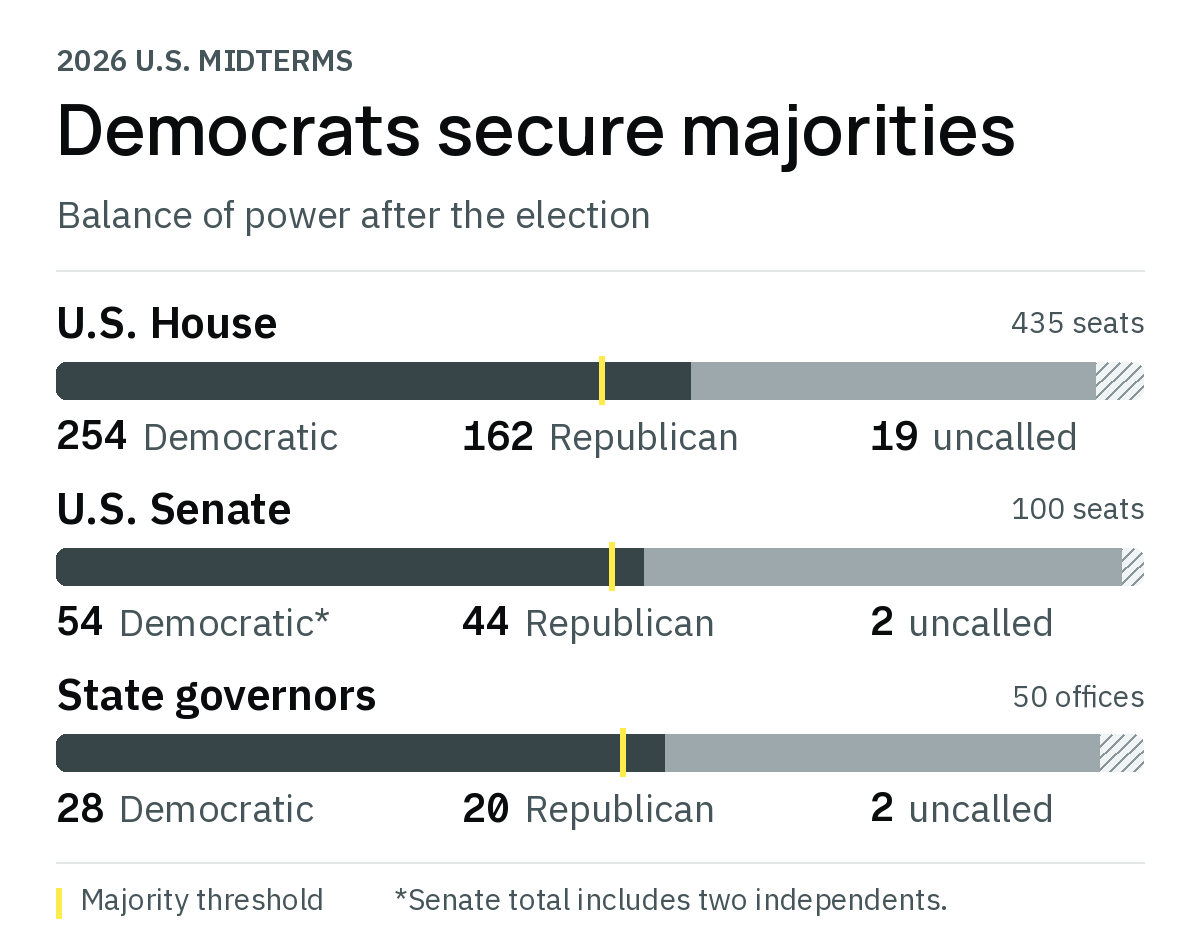
Their majority in the House—the largest in 36 years—creates the space for the party to have fractious debates without compromising their ability to govern. Much ink has been spilled on the role of leftists in the Democratic party. But with a 260-seat majority, 40 representatives can defect on any given issue and the Democrats still have the votes to pass legislation without any Republicans on board. While Democratic leader Hakeem Jeffries, who will likely be Speaker of the House, is not as seasoned at keeping his caucus in line as Nancy Pelosi, his predecessor, many of the new members to which the party owes its majority are moderates from districts that Trump won in 2024. The leftist caucus can do its political work but is not able to make policy demands. The Senate majority depends on senators in deep red states for whom fighting the left is good politics.
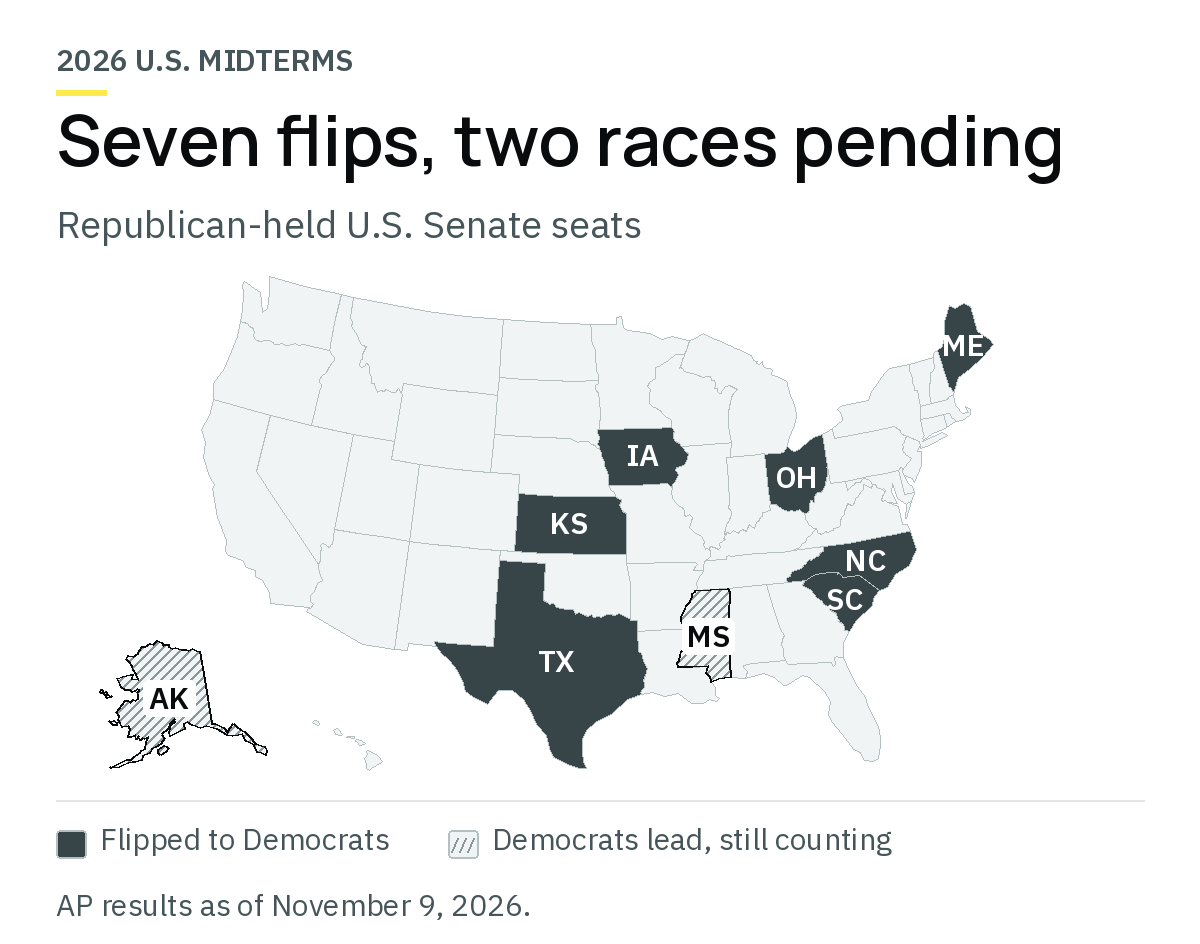
Democrats will represent South Carolina, Mississippi, Texas, Kansas, Ohio, and Iowa in the Senate in January. Donald Trump won each state by double digits two years ago. Their Senate majority is all-but-assured through 2030, and possibly even through 2032. I am not in the camp of some overzealous analysts that each of these states will be competitive in the 2028 presidential election. This cycle was an anomaly made possible by environmental conditions unique to this moment, the strength of Democratic candidates, the unusual weakness of Republican candidates, and the person of President Trump. Some might say that those factors are correlated. Sure—but they are extremely unlikely to manifest again in two years.
Of course, Donald Trump is still president. The Supreme Court has been deferential to his administration. He has enormous agency still. He will be able to block any attempt to undermine his legacy or biggest priorities. His choice of how to engage the Democratic congress will play a major role in which bills become law in the next two years—or if divided government means gridlock and endless investigations and subpoenas.
What the Democrats Want
The conventional wisdom of the last two years was that a leftists versus moderates civil war was going to play out in the 2028 presidential primary, and the leadup was mere jockeying for position. Many of the 2026 primaries were framed in this way. After much consternation, normal moderates defeated weird leftists in every senatorial and gubernatorial primary, except for the Michigan and Florida senate primaries where normal leftists defeated weird moderates.
The formula for the winning candidates was the same: a focus on affordability. Some people have tried to suggest other issues like aid for Israel or data centers were meaningful issues. Exit polls suggest that the overwhelming proportion of "gettable” voters cared primarily about the state of the economy. I think some of the confusion stems from Democratic candidates’ successful connection between the Iran war and a resurgence of inflation, and Republicans’ inability to distance themselves from it. But this election was decided by voters who determined that the administration was not doing enough on—and was responsible for—the rising cost of living.
Rather than the leftist revolution that many had foretold, instead, the Democrats that will be new to Washington in January were sent there to focus on bread-and-butter issues like affordability. They are not going to reinstate the Biden-era deference to esoteric special interests on the left. There is talk of Medicare-for-all, but barring some freak twist in which President Trump jumps on board—more on that at the end—Democrats are unlikely to use political capital to attempt anything meaningful on healthcare. Getting Obamacare across the line in 2010 was near-impossible even with a once-in-a-generation president and massive congressional majority, and the party was punished severely for it in the subsequent election. Medicare-for-all is a better soundbite to use as a cudgel against Republicans in 2028 than a serious policy priority.
Other than “make things more affordable,” it is not clear exactly what they want to do. Democrats have been out in the political wilderness for two years. They have been reflecting on how to win again, not necessarily how to govern. There are some measures that align with that mission and Congressional powers. There are already reports that the new majority will pursue legislation that effectively rolls back Trump’s tariffs on Canada, either directly or indirectly by limiting presidential authority. The Democrats will need Republican help; 11 senators and 30 representatives would be needed to overcome President Trump’s expected veto. They assert that, now that President Trump is a lame duck, the votes are there. But beyond Canada, it’s not clear there is much political will for undermining the president’s tariffs, because the underlying logic about non-tariff barriers in places like Europe, Japan, and South Korea is sound, and investment deals with Japan and South Korea are already being implemented. The China tariffs are broadly popular. Democrats would agree the “natural” tariff rate on goods from China that considers unfair economic practices and geostrategic interests is at least 15% anyway, and probably much higher.
Besides, the primary cause of resurgent inflation is the Iran war. It is difficult to see how the Democrats can bring about its end. Without getting into the minutiae of process and constitutional authorities, history suggests that Congress will not undermine the president as long as American servicemen are in harm's way. The cost of being seen as unsupportive of the military is, historically, too high for most members of Congress. The war will end on President Trump’s timeline. But Congress will not bail him out of this political mess.
Another big issue in the next two years is AI. Exit polls did not indicate AI was a strong motivator among voters, but there are good reasons to believe it will loom large in the next Congress. First, the AI boom is at present the lone bright spot in the US economy, and the pace of technological change is rapid. Second, while AI wasn’t a specific consideration, it intersects with issues that were: affordability and a perceived elevation of corporate interests over public and community interests.
I think the media is exaggerating opposition to data centers based on election results. It is true that Democrats successfully tied data center centers to cost-of-living considerations (particularly electricity generation) at the local level in a few places. Data center construction is bringing in the kinds of highly paid non-college jobs that moderate Democrats love. Newly elected Democratic governors in Wisconsin and Texas have made it clear they are not opposed to all construction; just that complete deference to corporate interests is not appropriate. Local interests should be considered. Josh Shapiro—re-elected as governor of Pennsylvania by a 21-point margin—has already charted that path, making loud pronouncements about protecting labor and local interests to secure better deals for communities. The projects proceed anyway. I doubt we will see a major discontinuity on data center construction.
The area where you could see some discontinuity with current policy is AI safety. Congress has yet to legislate on AI directly. The federal government is engaged in regulating AI through rulemaking and court judgments, applying existing authorities to AI. However, Anthropic, Coefficient Giving, and the effective altruist (EA) community have spent tons of money lobbying Congress and expanding their influence through think tanks—my super-rough-estimate puts it at easily north of $100m in 2026. Republican staffers in Congress noted that their Democratic colleagues received most of that lobbying attention in the second half of the year with the growing anticipation of a new Democratic majority.
I do not expect the AI debate to settle cleanly along partisan lines. There are strange bedfellows with personalities like Dario Amodei, Bernie Sanders, and Steve Bannon all having their own reasons for being hostile towards the broad diffusion of AI. Many of the pro-diffusion voices will have little influence with the new Congress, having been too nakedly partisan in the past two years. But the diffusion camp is broad and large—there are still plenty of constituents who want to see AI growth. And since AI was not a direct issue, Democrats in Congress still have broad latitude to work out their position on the issues.
What President Trump Wants
President Trump and Vice President Vance connected the Iran war to affordability and named it as the primary reason for Republicans’ defeat. The president sees the war as a long-term problem that he has an obligation to see through. There is still no deal to end the war. Democrats are happy to let that albatross weigh down Republicans but won’t stage a showdown with President Trump over it.
He genuinely seems done with Israel, which will endear him to Democrats. I think the signs have been there for many months now. I remember watching a press conference in June in which he repeatedly and unprompted expressed displeasure with Israel’s maximalist approach to the war (particularly in Lebanon). The day before the election, he announced the end of aid by the end of the year. In his post-mortem with Ross Douthat, he asserted that Israel owed its survival to him and would pay back the United States (a narrative device typically reserved for his most despised targets, like Mexico).
One possible surprise is immigration policy. President Trump expressed a view that the hardline immigration policy of his first two years was “too tough.” He thinks the job of removing criminals and securing the border is mostly done. He is open to a deal on settlements for one-time offenders—if their only offense was illegal entry or overstaying their visa—with jobs to stay in the country. Such a deal resembles proposals that were popular among Democrats across multiple administrations in the past. The question is whether the well is so poisoned on immigration that Congress rejects any cooperation with the administration regardless of the details.
President Trump has a more developed position on artificial intelligence policy than most members of congress. He is bullish on the market, pro-diffusion, and skeptical of AI safety and regulatory capture efforts from the big labs. He thinks of AI diffusion in the context on competition with China. He also expressed he would “absolutely” work with Democrats on AI safety but is not interested in regulation that handicaps America’s competitive position with respect to China.
It is somewhat surprising to engage in the accounting of these policy positions, because they look remarkably similar to moderate Democrat positions. President Trump expressed a willingness to have a constructive relationship with Democrats, and many new Democrats have indicated a reciprocal interest. Above all else, what the president wants is not to be impeached and investigated. Just as in 2018, the president has made it clear that he will fight the Democrats hammer and tongs if they use their newly recovered power against him personally. There will not be any cooperation if the 2019-21 pattern of investigations and impeachments repeats itself.
Three scenarios for the next two years
We see three main scenarios that reflect the political incentives of the major players the next three years:
- Divided Government: Live and Let Live. Our baseline forecast. We don’t expect some great political reconciliation, but with two years left in the Trump era, neither side is interested in relitigating the past or dragging out new versions of the same old fights that the public appears to be increasingly tired of watching play out.
- Divided Government: Live and Let Die. There is too much antipathy to bury the hatchet, and too much of an interest in settling scores. Both sides embrace scorched earth lawfare; the work of government grinds to a halt.
- Trump Turnabout. The president has never cared about the Republican party or its orthodoxy more than his own brand and connection with his base. Freed from electoral politics for good, we consider the dramatic possibility that Trump becomes a “Republican in name only” and governs solely in pursuit of popular policies to burnish his legacy.
Divided Government: Live and Let Live (60%)
President Trump starts by firing the least popular members of his cabinet, starting with Secretary of War Pete Hegseth. Hegseth is loathed by many members of Congress, including many Republicans. In private, many current Pentagon officials are happy to talk about his many defects and few virtues. Trump fires him before he can be impeached.
There is a tacit understanding between President Trump and the Democrats that there will be investigations of the administration’s corruption and incompetence, but they stay scoped to the outer circle and former officials who were already out of President Trump’s good graces: Kristi Noem, Corey Lewandowski, Kimberly Guilfoyle. The president’s family is ignored. The more competent members of the cabinet like Scott Bessent and Marco Rubio continue in their roles and have constructive relationships with many of the new Democrat committee leaders.
There are still fights, but they are not the existential crises in the way the first Trump administrations impeachment battles were. Think Scott Bessent and Elizabeth Warren’s social media sniping, government shutdowns, and bully pulpit corruption charges (rather than actual legal process). There are one or two constructive bills that get passed, but they are small, marginal improvements on things like AI safety or immigration. Along with Republican support, the Democrats override a Trump veto to remove tariffs against Canada, but that signals the end of the battle for trade policy.
Divided Government: Live and Let Die (30%)
The Democratic caucus is fractious and only unified by antipathy toward President Trump. They fire up the engines of lawfare and investigate the president and his family for corrupt business dealings—there is much material to work with and their base revels in the pageantry of seeing Trump impeached for the third time.
Trump and his administration dig in their heels. The Department of Justice ramps up investigations of the president’s enemies: members of Congress, the Clintons, the Bidens, the Obamas, left-leaning interest groups, Democrat-aligned business leaders. Nothing gets done in Washington – literally. The government is consumed by investigations and counter investigations. The government is shut down for many months, only reopening—briefly—when public concern reaches a fever pitch about safety and security issues like air traffic control and military readiness.
President Trump takes steps to protect himself and his family after the 2028 election, including preemptive pardons. But it is not enough to convince him he will not die in prison if the Democrats win the presidency. He puts his finger on the scale—heavily—to support the Republican candidate, pushing the bounds of legality even further than January 2021. If they win, the Democrats inherit a broken government and a public rift that takes a generation to heal.
Trump Turnabout (10%)
President Trump’s top priority is leaving office on a high note. His legacy is tied to his popularity. He determines his best path to securing a positive legacy is by enacting major legislation that enjoys significant public support. He has no more elections to run in and does not care much about the state of the Republican party after he retires. He has never been particularly ideological on many issues of party orthodoxy, seeing the party merely as a vessel for the Trump political brand.
While there is too much baggage for Trump to get a major deal with Democrats on immigration policy, there is another area he has neglected for eight years: healthcare. President Trump embraces Medicare-for-all, which has the support of two-thirds of voters. He and the Democrats work to pass legislation formally evolving the US healthcare system into a public-first paradigm, which he demands is referred to as “Trumpcare.” Many Republicans in Washington are aghast at his defection, but there is nothing they can do about it, and much of Trump’s base is delighted that their champion has delivered "free” healthcare.
The Republican party is in disarray going into the 2028 election, with candidates bamboozled about how to talk about Trumpcare during the campaign. The outgoing president does not care—his approval ratings have climbed to an all-time high, surpassing 50% for the first time. The Democrats clobber the Republicans in the 2028 election, and President Trump happily reminds anyone who will listen that the party is nothing without him.